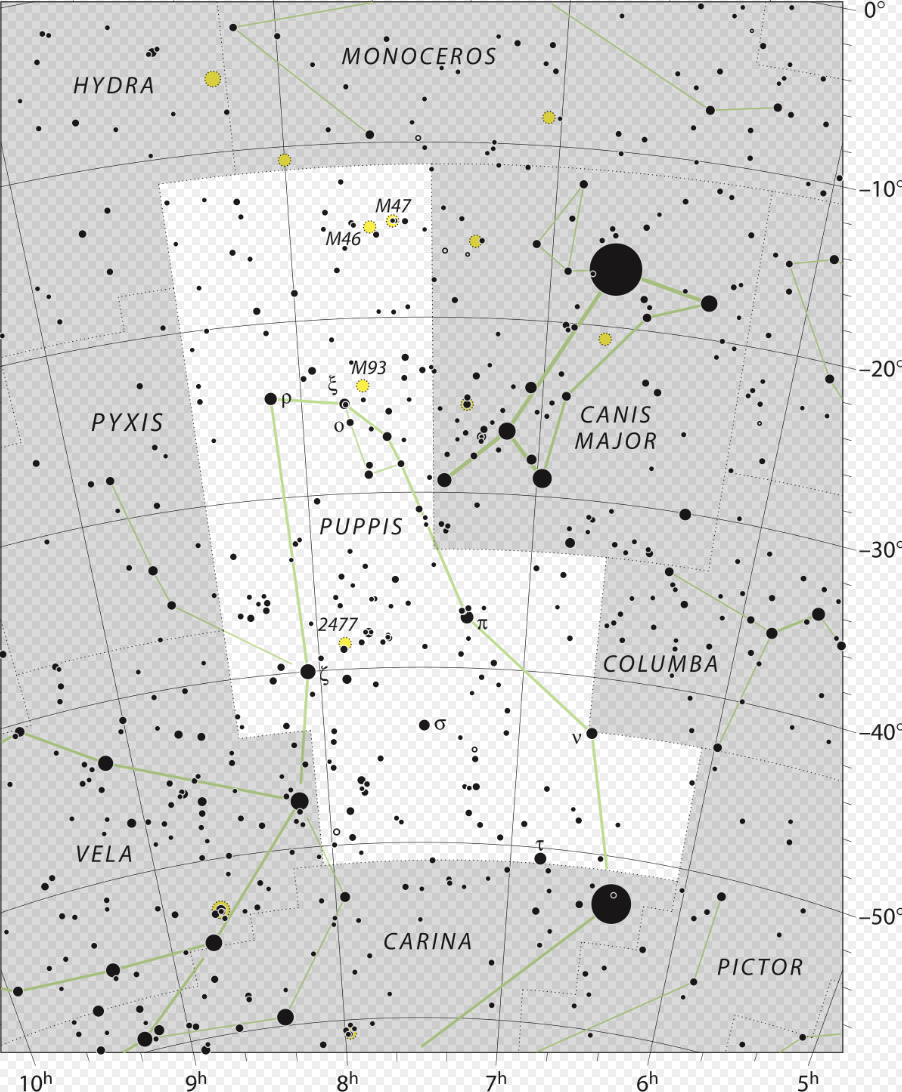
CG4, also known by the more evocative name “Hand of God,” is a cosmic cloud of gas and dust located about 1,300 light-years from Earth in the constellation Puppis. Its distinctive feature is its resemblance to a comet. It has a dense head, with an estimated diameter of 1.5 light-years, and a long tail extending for about 8 light-years. It is this resemblance that explains why astronomers classify it as a “cometary globule.” Despite its ominous nickname, CG4 is actually a veritable cradle of stars. The dense head of the nebula is an environment rich in hydrogen and dust, which provides the fuel necessary for star formation. Images of CG4, such as this one, often give the impression that it extends toward a nearby spiral galaxy. This is simply a perspective effect. This galaxy, named PGC 21338, is located 145 million light-years away, but is actually much farther away and lies in our line of sight toward CG4.